Crossing Slowly
Attraversando Lentamente


All rights reserved for respective artists. The captions for each image are available below.
Participating artists
Allegra Martin, Antonio Andretta, Camila Curiel, Celestino Marco Cavalli, David Michel Fayek, Francesca Marconi, Ibrahima Mbengue, Karim El Maktafi, Leila Mirzakhani, Liana Ghukasyan
Research and Curation
Yohsuke Ishizuka
Support
Viafarini
Introduction
Migration is a widely discussed social issue in Europe, including Italy. What cultural significance does it have? The movement of people creates new landscapes by blending different cultures. How exactly does this happen? The online exhibition "Crossing Slowly / Attraversando Lentamente" explores this question by showcasing the works of Italy-based artists.
Crossing a border is a brief action. After all, a border is just a line. However, reflecting on the Italian equivalent, "attraversare," offers a different perspective. In addition to the basic meaning of "crossing," the word also means "to go through," for example, "to go through a difficult time" (attraversare un momento difficile), which suggests a longer duration of time needed for an action. In other words, "attraversare" blurs the distinction between crossing and going through. Inspired by this idea, this exhibition views migration as a process rather than a short action.
Migration can have a significant impact on a person that lasts a lifetime. One may go back and forth between different cultures, experiencing changes both physical and mental. It is common for people to deal with their current life while reflecting on their past and upbringing. Thus, this online exhibition suggests finding a way to understand migration as a gradual change-inducing phenomenon.
The works in this online exhibition encourage us to understand the significance of migration. Rather than making snap judgments or clinging to prejudice and bias, patience and imagination are needed to grasp its magnitude.
This online exhibition is based on research conducted by Yohsuke Ishizuka during his residency at Viafarini from May to June of 2026.
Celestino Marco Cavalli

The final part of the trail, Italy from the project “Miriadi", 2023, Photography
© Celestino Marco Cavalli

Traces of passage on the trail from the project “Miriadi", 2024, Photography
© Celestino Marco Cavalli
The series "Miriadi" (2023) by Celestino Marco Cavalli is an intervention to the immigrants' path near the border between Italy and France. After noticing people walking on the highway, Cavalli learned that some immigrants try to cross the border on foot. The path leads deep into the forest, where it is pitch dark at night and easy to lose one's sense of direction. In an attempt to bring activism through art, Cavalli painted phosphorescent marks on the stones along the path to guide immigrants who aim to reach the French border in the dark. The series highlights the unreliability of borders and the vulnerability of individuals facing denied entry. The series also shows clothes along the path, presumably abandoned by immigrants trying to lighten their load so as not to appear to be traveling long distances. Crossing a border is, if successful, a matter of seconds, but examining the journey reveals more stories. Cavalli's series "Miriadi" is an unprecedented project that sheds light on this aspect of immigrants' experiences. Rather than taking a reportage perspective, Cavalli intervenes with care. This project changes our perception — a simple yet brave gesture can provide a safety net.
Ibrahima Mbengue
Ibrahima Mbengue is a photographer and filmmaker who is currently based in Milan. He grew up and received his education in photography in Dakar, and he previously worked on projects in Morocco. In Milan, while he worked on his artistic practice, he realized the exhibition project "Milano // Dakar," which aims to foster an artistic dialogue between Africa and Europe. This online exhibition features works from the artist's series "Rituals and Traditions Among the Dioulas" (2024). These photographs were taken in September 2024 during the festival of the king of Oussouye in Casamance, southern Senegal. Mbengue captured a combat ritual of the Diola tribe with his camera. The top image specifically shows a celebration called "Bakku," held after a combat victory. The image below shows women of different generations wearing skirts of various colors, which signify their ranks as wrestlers. "After the blessing was given, wrestling matches began throughout the south, as did the harvests," Mbengue adds. Mbengue's work showcases the multifaceted perspectives of an immigrant artist. Migrating to Europe does not mean disowning one's roots. Furthermore, returning to Senegal after migrating to Italy gave Mbengue the opportunity to see his country of origin from a different perspective. In this case, he was able to discover areas, cultures, and people he hadn't encountered before. Migration is not necessarily a one-way movement, but rather, it opens up the possibility of viewing a familiar culture from different angles. Values are so deeply interwoven into each specific culture that understanding traditional cultures across borders is more challenging than it seems. This series highlights the importance of continuous dialogue in overcoming the difficulty of understanding different cultural codes.


From the series ""Rituals and Traditions Among the Dioulas" (2024)
©Ibrahima Mbengue
David Michel Fayek

Nizam, 2023, Acrylic, plaster and contact print on canvas, 60x50cm
©David Michel Fayek

Realm of broken voices, 2025, Acrylic, handmade contact print, bleach, coffee powder on Magnani etching cotton paper mounted on wood board, 45x34.5cm
©David Michel Fayek
David Michel Fayek's series "Inner Mental Space" showcases how colonial legacies have been passed down through history by analyzing visual memories. The blurred images of crowds, printed on canvas and paper, and intervened with other materials, seem to provocatively ask viewers what they see. Fayek critically examines the use of photography by colonizers in Egypt and other colonies, especially the documentation of masses. Collective bodies are a natural phenomenon of society. However, such images were used to represent disorder, particularly to justify the intentions of colonizers. Fayek writes, "The term Nizam is closely tied to the concepts of order and discipline. Under British occupation, Nizam was often invoked to justify imperial control. Afterwards, Egyptian nationalists have also adopted the term, envisioning a new concept rooted in Egyptian sovereignty." While colonialism is a common theme in historical studies, in the context of this online exhibition, it can also be viewed as a form of migration that has had profound effects, perhaps the most violent in human history. Fayek's work makes viewers rethink the absurdity of crossing borders to exploit resources and expand territories through violence. It also emphasizes the importance of critically examining how colonial memories are formed.
Karim El Maktafi
Karim El Maktafi's photographic series, "They Call Us Second Generation" (2019–2021), explores the lives of young people living in Milan. As the title suggests, the subjects are people born in Italy to immigrant parents or who immigrated to Italy at a young age. The series depicts portraits of these figures alongside urban landscapes, primarily of residential areas. Through El Maktafi's lens, the images hold a sense of serenity. In his work, bustling metropolitan life seems to pause, allowing the subjects to become the protagonists of the story. In this calmness, everything looks normal — people are in their banal moments, with the favorite everyday clothes and the accessories, perhaps. Yet, at a certain point, one notices that the title of the project conveys a sense of struggle and pain. El Maktafi, who was born in Italy to a Moroccan family, often encountered situations where he was seen as a foreigner in Italy. He also shares that not everyone he has met has been granted citizenship, which leaves them feeling unrooted. The Jus Soli legal principle, which determines a person's citizenship by their place of birth, has appeared on the political agenda in the past, but implementation has not moved forward. His curiosity about other young people in the city motivated him to embark on this photographic research project, and the series realistically showcases such struggles. The series suggests that the identities of immigrants and their descendants cannot be "solved" in the name of integration — it is necessary to listen to people who live between multiple cultures. The ultimate question emerges: What does it mean to be Italian? The series also showcases the potential of photography as a means of compassion and solidarity in the pursuit of tranquility.
xxxx

From the series "They Call Us Second Generation" (2019-2021)
©Karim El Maktafi

From the series "They Call Us Second Generation" (2019-2021)
©Karim El Maktafi
Camila Curiel

Neo from "La merenda (T-Time)” series, 2026, intervened Delftware dishes
©Camila Curiel

Ukr_1 from “La merenda (T-Time)” series, 2026, intervened Delftware dishes
©Camila Curiel
Camila Curiel's ceramic series "La merenda (T-Time)" (2026 - present) showcases the artist's unique perspective on social dynamics, particularly in the Global South. Curiel moved to Milan from Caracas, Venezuela, to pursue her studies, and she has lived in the city ever since. In the meantime, Venezuela has undergone significant changes, including an accelerated refugee crisis, as well as U.S. intervention and political shifts in 2026. "La Merenda" can be seen as the artist's way of staying vigilant about the abuse of power and violence in her home country and beyond. The piece "Neo" depicts Neomar Lander, a young Venezuelan killed during a 2017 protest. Another piece, "Ukr_1," symbolically depicts the Russian bombing attack in Ukraine. Curiel transferred journalistic photos onto Delftware, creating a visual juxtaposition of classical fine dining tableware and extreme violence. In the past, images of such violence were disseminated through a limited number of channels, primarily for journalistic purposes. Nowadays, however, these images can be shared on social media and, ironically, appear on our smartphones daily along with food. Printing these images on ceramic ware hints at Curiel's determination to ensure they are never forgotten. Crossing a border doesn't mean forgetting the past; rather, it creates a new way of relating to the world.

CCSJ32026 from "La merenda (T-Time)" series, 2026, intervened Delftware dishes
©Camila Curiel
xxxx

ABUGHRAIB2004 from "La merenda (T-Time)" series, 2026, intervened Delftware dishes
©Camila Curiel
Camila Curiel's ceramic series "La merenda (T-Time)" (2026 - present) showcases the artist's unique perspective on social dynamics, particularly in the Global South. Curiel moved to Milan from Caracas, Venezuela, to pursue her studies, and she has lived in the city ever since. In the meantime, Venezuela has undergone significant changes, including an accelerated refugee crisis, as well as U.S. intervention and political shifts in 2026. "La Merenda (T-Time)" can be seen as the artist's way of staying vigilant about the abuse of power and violence in her country of origin and beyond. The piece, titled "CCSJ32026," portrays the bombing of Caracas by the U.S. Trump administration in early 2026. This act was part of the extraction of the then-Venezuelan president, Nicolas Maduro. Another piece, titled "ABUGHRAIB2004," symbolizes the torture of prisoners by U.S. forces at Abu Ghraib prison in Iraq. Ali Shallal al-Qaisi was one of those held there and subjected to torture for several months between 2003 and 2004. He was eventually released without charges. Curiel transferred journalistic photos onto Delftware, creating a visual juxtaposition of classical fine dining tableware and extreme violence. In the past, images of such violence were disseminated through a limited number of channels, primarily for journalistic purposes. Nowadays, however, these images can be shared on social media and, ironically, appear on our smartphones daily along with consumer products such as food. Printing these images on ceramic ware hints at Curiel's determination to ensure they are never forgotten. Crossing a border doesn't mean forgetting the past; rather, it creates a new way of relating to the world.
Francesca Marconi
The city of Milan is celebrated for its rich cultural diversity, which is especially evident in areas such as Via Padova. Since 2018, multimedia artist Francesca Marconi has explored this concept through her project "Internazionale Corazon". Milan has a group of young dancers called the Sambos de Corazon, who perform the traditional Bolivian Caporales dance in distinctive costumes characterized with embroidery. After holding workshops in Milan with the dance group and Caravaggio Art School, Marconi traveled to Bolivia to design costumes with a contemporary twist. The costumes feature words and symbols reflecting Milan's multiculturalism, such as "Via Padova State of Mind" and "Kebab." Local Bolivian dancers wore the costumes, and then they were brought back to Milan, where new dances were created. The importance of Marconi's project lies in its ability to make this reality visible and transform culture into a lived experience through community engagement and corporeality. The "Internazionale Corazon" project also demonstrates that migration is not merely an inward flow of culture but rather a multifaceted exchange open to interpretation. Furthermore, although the Caporales dance developed in the 20th century, it is connected to Saya, a traditional Afro-Bolivian musical genre. Thus, the Caporales dance contains multiple layers reflecting the country's history of African slavery, indigenous communities, and colonialism. "Internationale Corazon" showcased the diversity of cultures in Milan and beyond, serving as a declaration against the forces of homogeneity and a lack of imagination.


Images from the project "internazionale corazon, Adrielly" (2019)
Courtesy of the artist ©Francesca Marconi
Liana Ghukasyan

Falling Stars, 2024, Oil on canvas, 210×210 cm
©Liana Ghukasyan

Stelle Inesistenti, 2019, Oil on canvas, 127×90 cm
©Liana Ghukasyan
Liana Ghukasyan received her art education in Armenia before moving to Milan to continue her studies. She recalls that her education in Italy, which included live drawing, was liberating compared to her studies back home. Body image frequently appears in her paintings, as seen in the two works featured in this online exhibition. "Falling Starts" (2024) depicts a person lying on a bed, held firmly by a hand. Ghukasyan explains the symbolism of the bed: "The bed is not simply a place of rest, but a space where intimacy, vulnerability, memory and transformation meet... It holds the invisible traces of everyday life and becomes a landscape where the body preserves emotions, relationships and personal history. Through the image of the bed, I explore the fragile boundary between the private and the collective, inviting viewers to reflect on the universal experience of being human." The sharp contrast between the translucent blue and darkness leaves a memorable impression on viewers. The other work, "Stelle Inesistenti" (2019), also presents disharmony between the central figure and black hand. "The body becomes a place of storytelling, an uncomfortable yet tender and vulnerable space where identity is constantly transforming and never fixed," she shares. The difficulty of coexisting, or even direct conflict, is palpable in Ghukasyan's work and resonates with individuals who cross over to a completely different culture. Embracing "the other" is difficult, especially when one is fragile and seeking intimacy. Is it possible to stay to oneself, like the protagonists in her works who hold on to their own colors when surrounded by darkness?
Antonio Andretta
The photographic series "My Life Now, It's Okay" (2023) by Antonio Andretta provides a narrative on the living conditions of African immigrants in Italy. Andretta's approach was more anthropological than journalistic; he spent time with the immigrants before photographing them. They had endured a horrific journey across the African continent and a treacherous sea voyage to Italy. Life after arriving in Italy is not easy, Andretta adds. They often end up being forced to work long hours in harsh conditions in the agricultural sector. The title of the project is a quote from Mohammed, one of the people Andretta made acquaintance with, and it reflects the immigrants' resilience. Despite their traumatic experiences during their journeys, the quote shows their will to move on and find new lives. The images created by Andretta in collaboration with the immigrants depict how human connections are formed across borders. The images of a football field and people playing on it are highly symbolic in the series. Andretta explains that immigrants don't necessarily speak the same language, but they play football together and improvise on the field, for example, using stones to make a goal. Andretta's work visualizes human connections, which are difficult to establish in an unfamiliar place, especially after experiencing mistrust. Such bonds appear precious, formed right after being rescued at sea, even if it is an ephemeral moment. When moving from one place to another, immigrants must face a new reality. Andretta's work seems to slow down this dynamic journey, even if only momentarily, creating an opportunity to celebrate human connections.


From the series "My Life Now, It's Okay" (2023)
©Antonio Andretta
Leila Mirzakhani

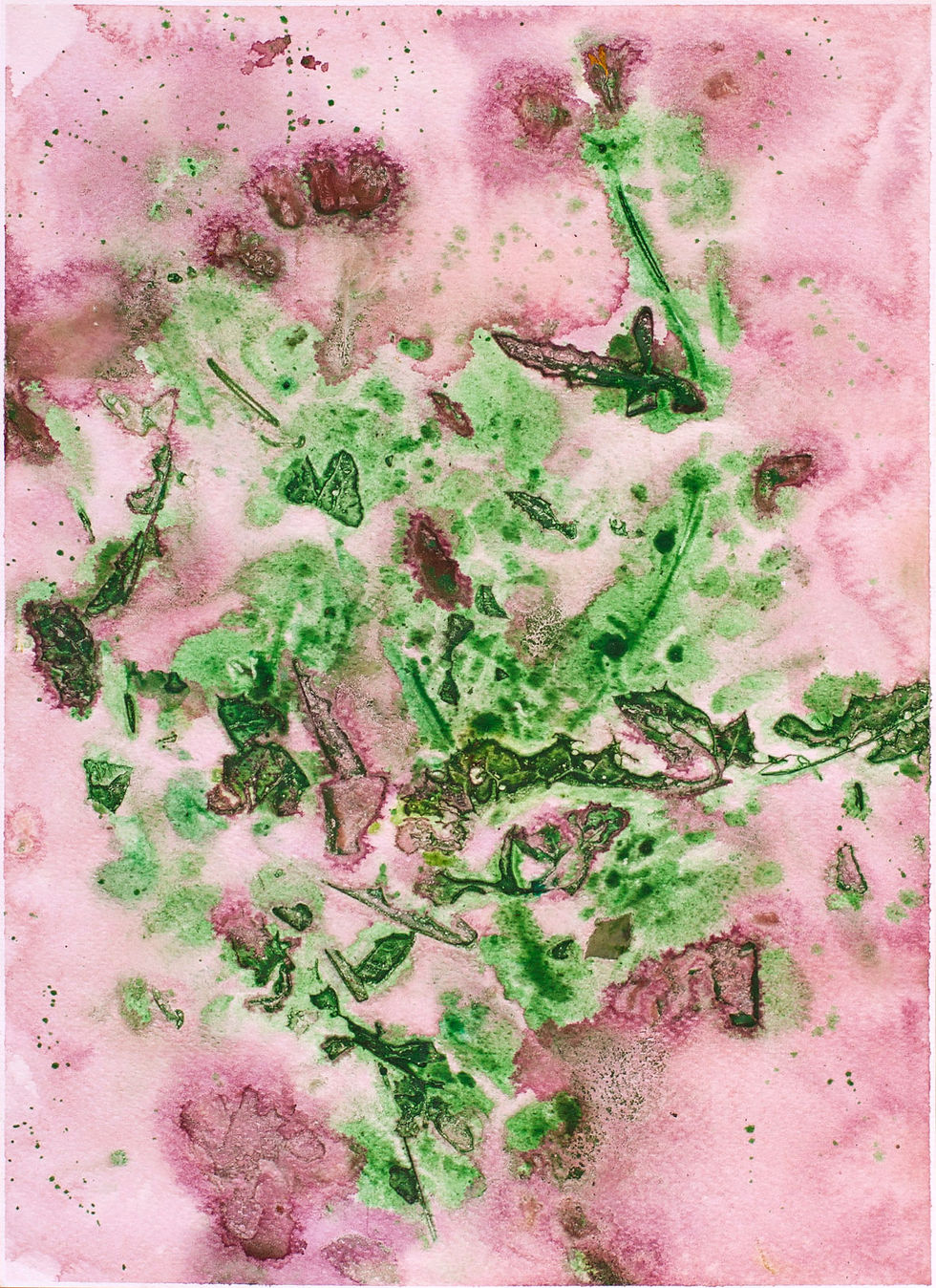
Seaseons Poetry #44, watercolor on canvas, 33x24cm
©Leila Mirzakhani
Seaseons Poetry #53, watercolor on canvas, 33x24cm
©Leila Mirzakhani
The watercolor drawing series "Seasons Poetry" (2023) by Leila Mirzakhani offers an intriguing perspective on the artist's cross-cultural experience. After studying art in Tehran, Mirzakhani pursued further studies in Rome. The works in this series feature abstract forms that resemble microorganisms, creating the sensation of observing water in nature under a microscope. The atmosphere is still and calm, yet fluid. Mirzakhani explains that her interest lies in primitivism, which is evident in her works inspired by nature. But how does she work with the huge gap in artistic tradition between Iran and Italy? In this regard, she shares the importance of poetic expression in Iranian culture. Poets such as Omar Khayyám continue to influence her work. "It's not just me," she adds. "Many people in Iran read poetry in everyday lives." The abstract images Mirzakhani creates are remotely yet firmly connected to her interest in decoding poetic codes. Her works also spark an intriguing discussion: Is the impermanent nature of existence, which lies at the core of her practice, a universal perception or a strong Asian tradition? Perhaps nature is Mirzakhani's way of delving into this concept and communicating it to people across different cultures.
Allegra Martin
The photographic series "On Board" (2009 - present) by Allegra Martin offers a unique perspective on the concepts of movement and crossing. Through this series, Martin documents and investigates the interiors of ferries traveling across the sea near the Italian peninsula. Through her investigation, the peculiarities of these spaces become apparent. Most of the spaces she documented, including entertainment and dining spaces, have a hint of a utopian atmosphere. These spaces are designed to allow travelers to detach from their everyday lives. Eerily, these peculiar spaces are technically floating on the sea. As Martin points out, quoting Michel Foucault, this reflects the concept of heterotopia in contemporary society. The interiors of the ferries seem unconnected not only from terrains but also from the time in which we live. Crossing the sea to another island or shore in this constructed device is equivalent to dreaming, even though the spaces show signs of decadence and imperfection. It's not just a mode of transportation; emotions are tied to the movement, whether it comes naturally or is staged. One may wonder how many people cross the Mediterranean Sea every day in different modes of transportation, from luxurious private yachts to large ferries, gigantic tankers, simple wooden fishing boats, and even makeshift rafts. Do they all dream while crossing?


From the series "On board" (2009)
©Allegra Martin